DeepACO
DeepACO is a general combinatorial optimization framework that combines graph neural networks with ant colony optimization, using learned heuristics and neural-guided local search to find high-quality solutions.
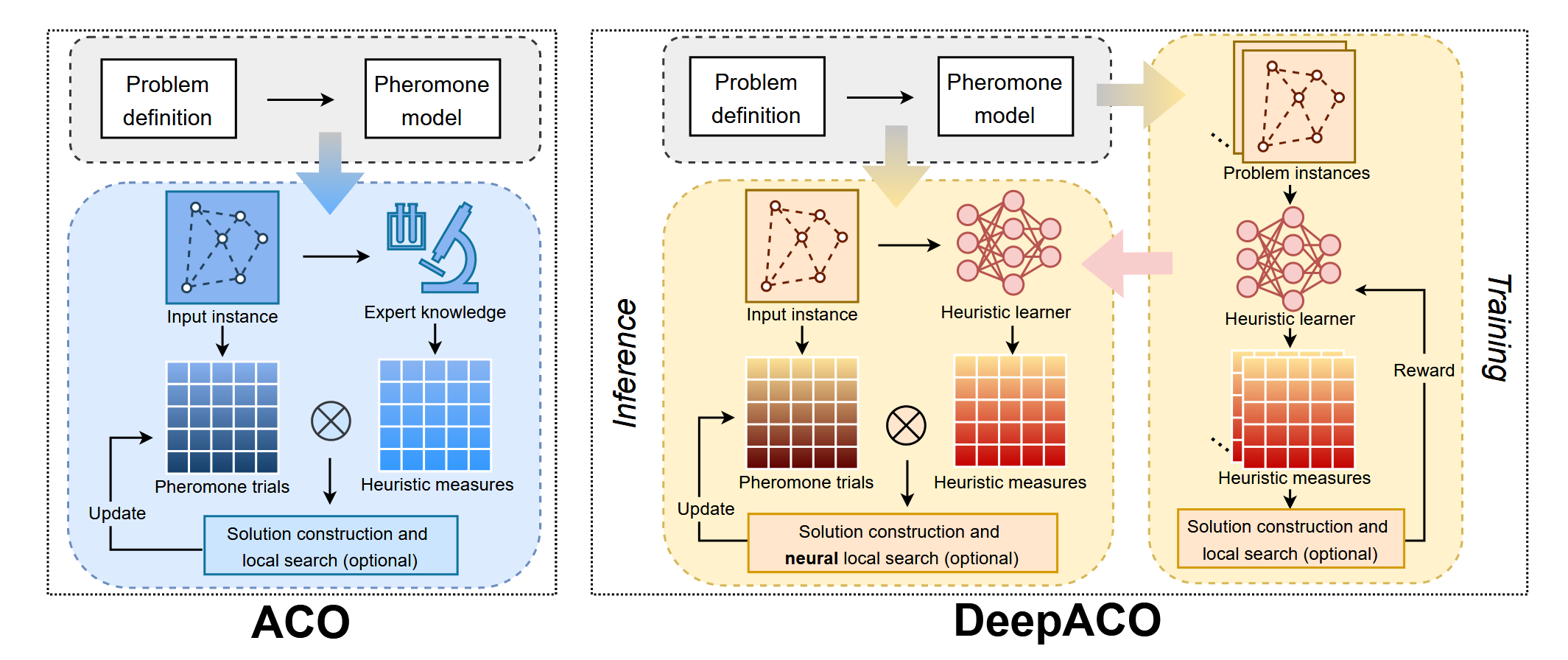
DeepACOInitialization
Bases: Initialization
Methods:
In training mode, the ACO policy is executed to collect rewards and probabilities.
In evaluation mode, multiple searches are performed based on the heuristic heatmap to output the solution scores.
DeepACOIteration
Bases: Iteration
Methods:
The ACO algorithm itself is an iterative algorithm, and when an ant constructs a feasible path based on heuristic measures, it corresponds to generating an initial solution.
The policy of this method is based on the ACO algorithm. Different problems are implemented by their respective
class ACO_{problem}, and then integrated throughload_policy.The model is based on a GNN network, mainly used for predicting heuristic measures in ACO.
ACO_{problem}
class ACO_{problem}(
  distances,
  n_ants,
  decay,
  alpha,
  beta,
  elitist,
  min_max,
  pheromone,
  heuristic,
  min,
  )
Parameters
n_ants(int): The number of ants used to construct solutions in each iteration.decay(float): The evaporation rate of pheromones in each iteration.alpha(int): Determines how much ants rely on pheromone concentration.beta(int): Determines how much ants rely on heuristic information.elitist(bool): Indicates whether to use the elitist strategy, i.e., whether the best path receives additional pheromone reinforcement.min_max(bool): Indicates whether to use the Min-Max ACO strategy, which imposes upper and lower bounds on pheromone concentration.min(float): Sets the minimum allowable pheromone value in the Min-Max ACO strategy.
Additional parameters
two_opt(bool): for tsplocal_search(str): for tspk_sparse(int): for tsp, pctspadaptive(bool): for cvrpswapstar(bool): for cvrp
Supported ACO algorithms:
class ACO_TSP()class ACO_CVRP()class ACO_OP()class ACO_PCTSP()class ACO_SOP()class ACO_SMTWTP()class ACO_RCPSP()class ACO_MKP()class ACO_BPP()
load_policy
The load_policy is used to load the corresponding ACO algorithm based on different problems.
def load_policy(
  model,
  data,
  policy_param,
  env_name
  ) -> class aco
Parameters:
Model
DeepACO predicts the heuristic information of ACO using GNN. In particular, Transformer has also been used in MKP.
class Net(
  feats=1,
  edge_feats=1,
  update_x=True,
  phe_net=False
)
EmbNet(): update node and edge features to obtain edge embeddings.ParNet(): inherit from MLP to predict heuristic information.
Usage
You can run the following command lines to execute the code.
python train.py settings=deepaco_settings mode=train problem={problem} settings.model.feats={feats} settings.model.edge_feats={edge_feats} settings.model.phe_net={phe_net} settings.model.update_x={update_x}
python train.py settings=deepaco_settings mode=train problem=tsp
python train.py settings=deepaco_settings mode=train problem=op settings.model.feats=2 settings.model.phe_net=True
| problem | feats | edge_feats | phe_net | update_x |
|---|---|---|---|---|
| tsp | 1(default) | 1(default) | False(default) | True(default) |
| cvrp | ||||
| op | 2 | True | ||
| pctsp | 2 | True | ||
| sop | True | False | ||
| smtwtp | 2 | True | False | |
| rcpsp | 5 | 2 | ||
| mkp | 5 | True | ||
| bpp |
Tasks
Supported Tasks: TSP, CVRP, OP, PCTSP, SOP, SMTWTP, RCPSP, MKP, BPP.
Required Data Generator: