LIH
LIH is a combinatorial optimization framework that combines deep reinforcement learning with a self-attention-based architecture, leveraging learned improvement heuristics and policy network-guided local search to derive high-quality solutions for routing problems.
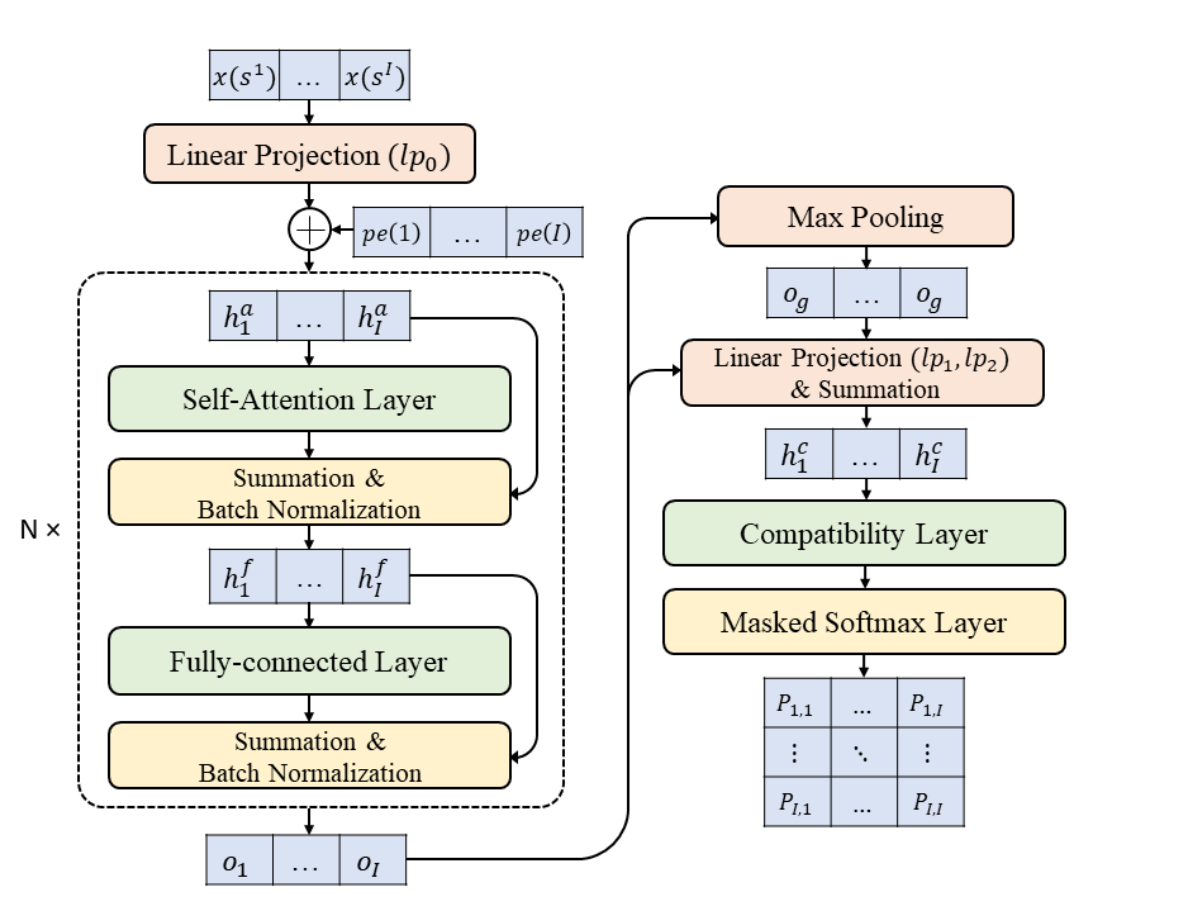
LIHInitialization
Bases: Initialization
Methods:
Initialization_tool
The Initialization_tool is used to generate initial solutions and calculate the length of these solutions. For the TSP (Traveling Salesman Problem), initial solutions are generated via the random initial method; for the CVRP (Capacitated Vehicle Routing Problem), initial solutions are generated using the nearest insertion method.
LIHIteration
Bases: Iteration
Methods:
2-opt: It improves the solution with the2-optoperator under given iterations.
LIHPolicy
class LIHPolicy:
    def __init__(
        self,
        env_name: str = "tsp",
        embed_dim: int = 128,
        init_embedding: nn.Module = None,
        num_heads: int = 1,
        qkv_dim: int = 128,
        num_encoder_layers: int = 3,
        normalization: str = "batch",
        feedforward_hidden: int = 512,
        **kwargs
    )
LIHModel
LIH is based on the Transformer architecture. In the encoder, it employs single-head attention, while in the decoder, full-graph maxpooling is added as supplementary information.
Usage
You can run the following command lines to execute the code.
python train.py settings=lih_settings mode=train problem={problem} settings.module.T={T} settings.module.n_step_return={n_step_return}
python train.py settings=lih_settings mode=train problem=tsp
python train.py settings=lih_settings mode=train problem=tsp settings.module.T=200 settings.module.n_step_return=4
| problem | scale | T | n_step_return |
|---|---|---|---|
| tsp | 20 | 200 | 4 |
| 50 | 200 | 4 | |
| 100 | 200 | 4 | |
| cvrp | 20 | 360 | 10 |
| 50 | 480 | 12 | |
| 100 | 480 | 12 |
Tasks
Supported Tasks: TSP, CVRP
Required Data Generator:
Policy
main loop
LIH starts by randomly generating an initial solution. The neural network then selects a pair of nodes for the 2-opt operation to improve the solution iteratively.
In the CVRP problem, each node is represented by a 7-dimensional vector, formed by concatenating the previous node $x_{t-1}$, the current node $x_t$, the next node $x_{t+1}$, and the demand.
Training
LIH applies autoregressive reinforcement learning class ARREINFORCELightning() for training.
training paradigm
TSP is trained using the A2C algorithm.
CVRP is trained using the PPO algorithm
Both of the training processes apply multi-step discounted rewards to improve stability and learning efficiency.